
Updated:
April 12, 2026
Published:
April 12, 2026
Publishing PWA in app stores: Options & limits
Progressive web apps (PWAs) are often positioned as a cost-effective alternative to native applications. They enable companies to deliver web-based applications with app-like functionality without having to do separate developments for iOS and Android.
In practice, however, there is a key challenge: Many companies also want to publish their application in app stores such as Google Play or the Apple App Store. This is where PWAs reach technical and strategic limits.
This article shows how publishing PWAs in app stores works, what restrictions exist and which alternatives make sense for companies.
What is a progressive web app?
A progressive web app is a web application that is extended by modern web technologies to create an app-like user experience. This includes service workers, offline functionality, and the ability to install the application on the home screen.
Compared to classic websites, PWAs offer:
- faster load times through caching
- Use even with limited Internet connection
- Cross-device availability
- no installation via app stores required
For companies, this means reduced development time and lower costs, especially for projects with a limited budget or a clearly defined range of functions.
Why companies want to publish PWAs in app stores
Although PWAs originally work without app stores, there is a desire in many projects to also be present on well-known platforms. There are several strategic reasons for this.
Visibility is a key factor. App stores are still an important channel for user acquisition and offer additional reach. At the same time, a listed application increases user trust, as app stores are associated with quality and security.
In addition, a classic installation process via the store makes it easier to use. Many users are not familiar with the concept of installing PWA via the browser, which can lead to friction losses.
Last but not least, marketing aspects also play a role. Reviews, rankings, and organic visibility within stores can significantly support the distribution of an application.
Publishing a PWA on Google Play Store
With so-called Trusted Web Activities (TWA), there is an established way for Android to publish PWAs in the Google Play Store. The web application is embedded in a native Android app, which runs in full screen mode without visible browser elements.
The technical approach is comparatively efficient as there is no need to develop a separate native application. Instead, the existing PWA is used as a basis and integrated into an app structure.
There are clear benefits to this approach. Development time remains short, updates can be rolled out directly via the web application and there is no duplicate code base. At the same time, the application can be listed in the Play Store and can be installed by users like a classic app.
However, there are restrictions. Performance remains heavily dependent on web architecture, and access to certain native features is limited. In addition, in many cases, the user experience does not reach the level of a fully native or optimized cross-platform app.
Publishing a PWA in the Apple App Store
In the iOS ecosystem, the situation is significantly more restrictive. Apple doesn't offer a direct way to publish PWAs on the App Store. Instead, the application must be integrated with a native iOS app, typically via a WebView.
This approach results in the PWA running in a type of container. This is technically feasible, but Apple has high requirements as part of the app review process.
It is crucial that the application offers clear added value compared to a pure website. Apps that only display web content are often rejected. In addition, it is checked whether native functions are being used sensibly and whether the application delivers a consistent, high-quality user experience.
For companies, this means that a pure PWA is rarely enough to meet the requirements of the app store. In many cases, additional adjustments or a different technological approach are required.
Limits of PWAs in an app store context
Publishing PWAs in app stores is technically possible, but comes with structural restrictions. These should be considered as early as the planning phase.
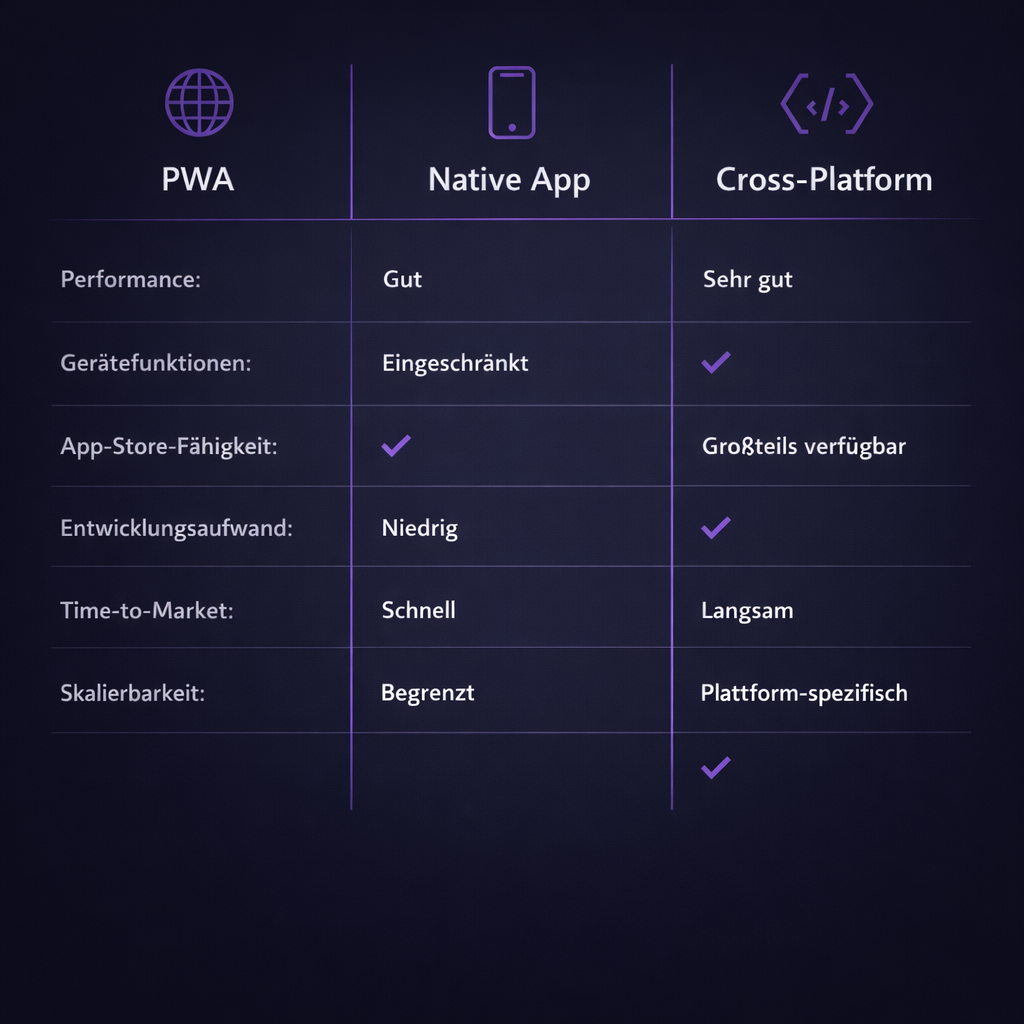
A key problem is limited integration into operating systems. While native applications are deeply integrated into device functions, access remains limited with PWAs. This includes push notifications, background processes, or hardware access, for example.
The user experience is also a challenge. Users expect apps to have specific behavior, high performance, and consistent interaction. PWAs can meet these expectations in many cases, but they don't always reach the same level as native solutions.
In addition, there is the additional effort involved in publishing. Especially in the Apple ecosystem, implementation via wrapper solutions requires additional development work and increases the complexity of the project.
When is a PWA the right decision?
PWAs are particularly useful when the focus is on rapid and cost-effective implementation. They are well suited for applications with a clearly defined range of functions and a low need for native features.
Typical application scenarios include customer portals, internal tools or digital services, which are primarily used via the browser. PWAs also offer a quick entry into the market for MVPs or early product phases.
However, as soon as a strong app store presence, high performance requirements, or complex features are required, this approach reaches its limits. In such cases, the technological decision should be reviewed at an early stage to avoid subsequent changes.
Alternative: Cross-platform apps as a strategic approach
For many companies, developing cross-platform apps is a more sustainable solution, especially as part of a professional App development. Technologies such as React Native or Flutter make it possible to develop applications for iOS and Android with a common code base without sacrificing native functionality.
Compared to PWAs, cross-platform apps offer better integration with operating systems, higher performance, and an optimized user experience. At the same time, development costs remain manageable compared to fully native apps.
This approach is particularly suitable for companies that pursue a clear app store strategy right from the start and want to scale their application over the long term.
Conclusion
Publishing Progressive Web Apps in app stores is technically feasible, but comes with clear restrictions. While Android offers a comparatively easy path with Trusted Web Activities, iOS has significantly higher requirements, which often require additional development measures.
For companies, it is therefore not only the technical implementation that is decisive, but above all the strategic arrangement. PWAs offer advantages in terms of cost and speed, but they are not the optimal solution in every scenario.
When the focus is on a strong presence in app stores, a high user experience and long-term scalability, a cross-platform approach is in many cases the more sensible choice.
knguru
We put this into practice in real projects.
200+ projects, our own app with 50,000 users
Limitations of PWAs in the app store context
Publishing PWAs in app stores is technically possible, but it comes with structural limitations. These should be taken into account as early as the planning phase.
A key problem is the limited integration with operating systems. While native applications are deeply integrated into device functions, access remains limited for PWAs. This affects push notifications, background processes and hardware access, for example.
User experience is also a challenge. Users expect apps to behave in a certain way, perform well and offer consistent interaction. PWAs can meet these expectations in many cases but do not always reach the same level as native solutions.
Another factor is the additional effort required for publishing. In the Apple ecosystem in particular, implementation through wrapper solutions requires additional development work and increases the complexity of the project.
When is a PWA the right choice?
PWAs make particular sense when the focus is on fast, cost-efficient delivery. They are well suited to applications with a clearly defined scope of functionality and little need for native features.
Typical use cases are customer portals, internal tools or digital services that are used primarily through the browser. For MVPs or early product stages, too, PWAs offer a quick way into the market.
However, as soon as a strong app store presence, high performance requirements or complex functionality are required, this approach reaches its limits. In such cases, the technology decision should be reviewed early to avoid having to switch later.
Alternative: cross-platform apps as a strategic approach
For many companies, developing cross-platform apps is a more sustainable solution, especially as part of professional app development. Technologies such as React Native or Flutter make it possible to develop applications for iOS and Android with a shared codebase without giving up native functionality.
Compared to PWAs, cross-platform apps offer better integration with the operating systems, higher performance and an optimized user experience. At the same time, the development effort remains manageable compared to fully native apps.
This approach is particularly well suited to companies that pursue a clear app store strategy from the start and want to scale their application over the long term.
Conclusion
Publishing Progressive Web Apps in app stores is technically feasible but comes with clear limitations. While Android offers a comparatively simple route with Trusted Web Activities, iOS has considerably higher requirements, which often call for additional development work.
For companies, it is therefore not only the technical implementation that matters, but above all the strategic assessment. PWAs offer advantages in terms of cost and speed, but they are not the best solution in every scenario.
If a strong presence in app stores, a high-quality user experience and long-term scalability are the focus, a cross-platform approach is the more sensible choice in many cases.




Between agency life and startups - our blog
In our blog we share tips on app development, startups and a few wild stories from everyday agency life.




Book your free call.
We look at your plans with you as if they were our own. If building does not pay off, we tell you, even when that speaks against the project.

Pick a day
Loading free times …