Updated June 6, 2026Published June 6, 2026
Nearshore vs. Offshore: The Honest Comparison for App Projects
 Louis Nell

Imagine this: You're a founder, your app idea is validated, the budget is set. Then the first offer comes from Germany – and you gulp. 95 Euros an hour. The second offer comes from India: 22 Euros. You quickly do the math, think "same service, a quarter of the price" – and sign.
Three months later, this is what it looks like: The daily standup takes place at 8:00 AM because the team in Bangalore is just finishing work. Feedback loops take 48 hours because queries are left unanswered overnight. The first design looks okay, but it doesn't resonate with German users – too much text, wrong hierarchy, onboarding completely different than expected. The project is eight weeks behind schedule. The hours are used up. The result isn't ready for launch.
This is not an isolated incident. It's the most common pattern we see at KNGURU when clients come to us after another setup has failed.
The Three Models – Explained Briefly and Clearly
Onshore means your development team is located in the same country as you. Highest cultural proximity, maximum control – but also the most expensive option, especially in the DACH region.
Offshore means your team is located in a distant country, typically India, Bangladesh, the Philippines, or China. Low hourly rates, significant time difference, high coordination effort.
With Nearshoring you work with a team in a geographically close, culturally similar country – for Germany, typically Serbia, Poland, Romania, or the Czech Republic. The time zone aligns, communication works in real-time, and developer quality is often on par with Western European standards.
The crucial difference between the three models is not the hourly rate – but the total effort. And this is precisely where theory diverges from practice.
The Honest Cost Comparison: Hourly Rate vs. Project Reality
Comparisons based solely on hourly rates are systematically misleading. What you truly pay for is not the hourly rate – it's the total price for a finished, launchable product. And that comprises more than most founders consider when looking at the first offer.
What Hidden Costs in Offshore Really Mean
- Communication Effort: Every query left unanswered overnight costs a day. With three queries per week over six months, this adds up to weeks of lost development time.
- Rework due to Misunderstandings: If a feature is implemented incorrectly because the cultural context is missing or the briefing was misunderstood due to time delays, you'll pay for it twice.
- Management Overhead: Offshore projects require more coordination, more documentation, and more interim calls. That's work time – either yours or that of a paid project manager.
- Time Delay: Missed Market Opportunity: Especially for startups, time-to-market is crucial. Every week of delay comes with a price that won't show up in any hourly rate.
Nearshore vs. Offshore: A Comparison of Key Criteria
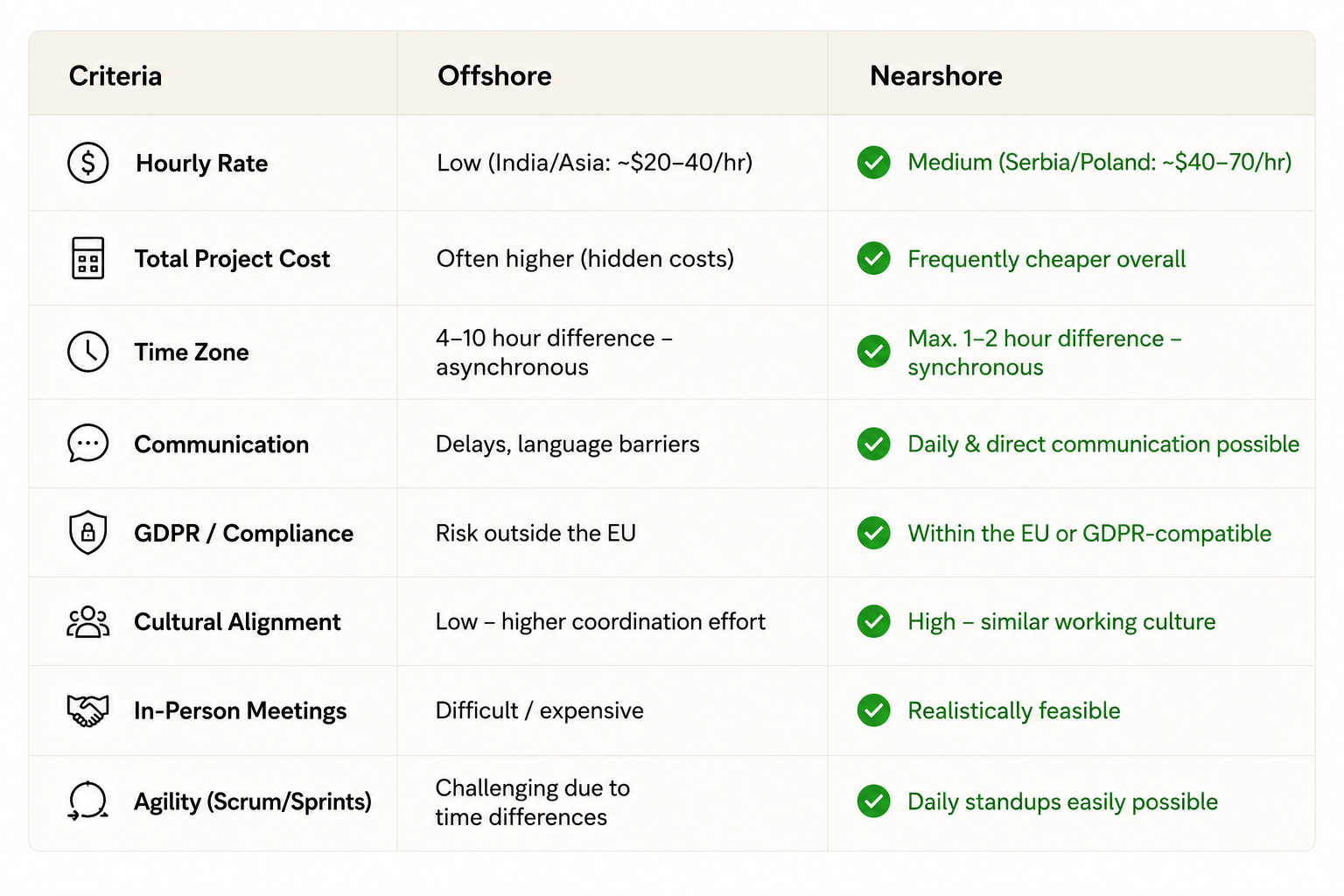
In seven years and over 200 projects, we've learned: The best digital collaboration doesn't work despite distance, but because the right structures are in place. Nearshoring creates precisely these structures.
The 5 Criteria That Truly Matter for Your Decision
Not all projects are alike. Whether Nearshore or Offshore is the better choice depends on your specific situation. Here are five factors you should honestly consider:
1. How complex is your product?
Simple, clearly defined tasks – such as a specific feature, a test module, or a backend task with full specifications – can be implemented well offshore. Complex products with an iterative development process, frequent changes in direction, and close coordination between design and development require short communication channels. This is where Nearshore clearly has the advantage.
2. How agile is your team?
Agile development – Scrum, sprints, daily standups – requires all participants to be reachable simultaneously. This is structurally difficult with a team in a different time zone. Those who native vs. Cross-Platform weigh development and rely on agile iterations should also include the team's location in that same decision.
3. How important is GDPR compliance?
Strict requirements apply to apps that process personal data – which is virtually every app. With a Nearshore partner within the EU or in a country with an EU data protection agreement, you are legally much safer than with an Offshore team in Asia.
4. How much time do you have for coordination?
Offshore outsourcing requires significantly more management effort. If, as a founder, you already work 60-hour weeks and are building your product simultaneously, the hidden time commitment for an Offshore setup poses a real risk to your overall project.
5. How important are in-person meetings?
Not every collaboration can be fully replicated remotely. Kick-offs, design workshops, quarterly reviews – for these moments, geographical proximity is a real advantage. With a nearshore team in Serbia, you can fly there in two hours. With an offshore team in India, you're planning a long-haul flight.
When Offshore is still the right choice
We are an agency that lives and breathes nearshoring – but we wouldn't be honest if we pretended offshore was always the wrong decision. There are scenarios where offshore works:
- Clearly defined, self-contained tasks with minimal coordination required (e.g., database migration, defined API integration)
- Highly cost-sensitive projects with a low degree of complexity and experienced internal project management
- Scaling projects where an existing, well-documented system is extended
- Support and maintenance tasks with clear SLAs and standardized processes
Offshore can make sense if specifications are fully available, communication can be kept to a minimum, and you have the capacity to manage the team closely. If any of these prerequisites are missing, the risks increase exponentially.
Leipzig meets Niš – KNGURU's own nearshore approach
We're not just talking theory here. KNGURU has its own nearshore setup that has been running for years: our design and development team is split between Leipzig and Niš in Serbia – approximately 1,400 kilometers, one time zone, same working hours.
What this means in practice:
- Daily coordination without time lag – feedback is returned the same day
- Cultural proximity – the same understanding of UX standards, design quality, and client communication
- Personal meetings – we fly to meet each other regularly, not just once a year
- GDPR-compliant setup – clear contracts, European infrastructure
In seven years and over 200 projects, we've learned: The best digital collaboration doesn't work despite distance, but because the right structures are in place. Nearshoring creates precisely these structures.
As App Development Agency with genuine nearshore expertise, we know what works in cross-location collaboration – and what doesn't. This knowledge is incorporated into every client project.
Checklist: Nearshore or Offshore - what suits your project?
Answer the following questions honestly. The more 'yes' answers you give, the clearer it is that nearshoring is the better choice:
- Am I developing a complex, iterative product (app, SaaS, platform)?
- Does my team work agilely with sprints and daily stand-ups?
- Does my app process personal data of German or European users?
- Do I lack my own project management capacity for intensive offshore coordination?
- Is time-to-market crucial for my startup?
- Am I planning design or kick-off workshops for which in-person attendance would be important?
- Do I value a team that truly understands my brand and my users?
- Is GDPR compliance non-negotiable for me?
3–4 'Yes' answers: Nearshoring is very likely the better option. 5+ 'Yes' answers: Nearshoring is clearly the superior choice for your project.
Between agency life and startups - our blog
In our blog we share tips on app development, startups and a few wild stories from everyday agency life.

How to Integrate PayPal in Your App: A 2026 Guide
How to integrate PayPal into your app: integration paths, requirements, a step-by-step walkthrough and the mistakes that cost you conversions.Read story
Software Development Outsourcing: When It Pays Off
When does software development outsourcing pay off, which models exist and how do you spot a good partner? An honest take, hidden costs included.Read story
Low Code Development: When It Pays Off and When It Doesn't
What low code can really do, where its limits are and when custom development pays off more. An honest take with a 2026 platform comparison.Read story
Book your free call.
We look at your plans with you as if they were our own. If building does not pay off, we tell you, even when that speaks against the project.

Pick a day
Pick a day
Loading available times …