Updated June 3, 2026Published June 3, 2026
What is Offshoring? Definition, Examples & Risks
 Louis Nell

You want to have an app developed, your budget is limited – and suddenly the word offshoring pops up everywhere. Cheap developers in India, a team in Asia, hourly rates that are hard to believe. Sounds tempting. But what's really behind it?
In this article, we explain what offshoring means, how it specifically works in app development – and when it's worthwhile for you as a founder or company. And when it's not.
What is Offshoring?
Offshoring refers to the relocation of business processes or entire business units abroad – typically to countries with significantly lower labor costs. The term comes from English: offshore literally means "beyond the coast" – i.e., far away.
In practice, this means: A German company outsources tasks such as software development, customer service, or accounting to a team in India, China, or the Philippines. The work is done there, and the results are returned – digitally, via email, or through project management tools.
Important: With offshoring, the company retains substantive responsibility. It decides what is built – the external team implements it. This distinguishes offshoring from complete outsourcing, where a third-party provider also takes over strategic decisions.
Offshoring, Outsourcing, Nearshoring - what's the difference?
These three terms are constantly confused. However, they describe different things:
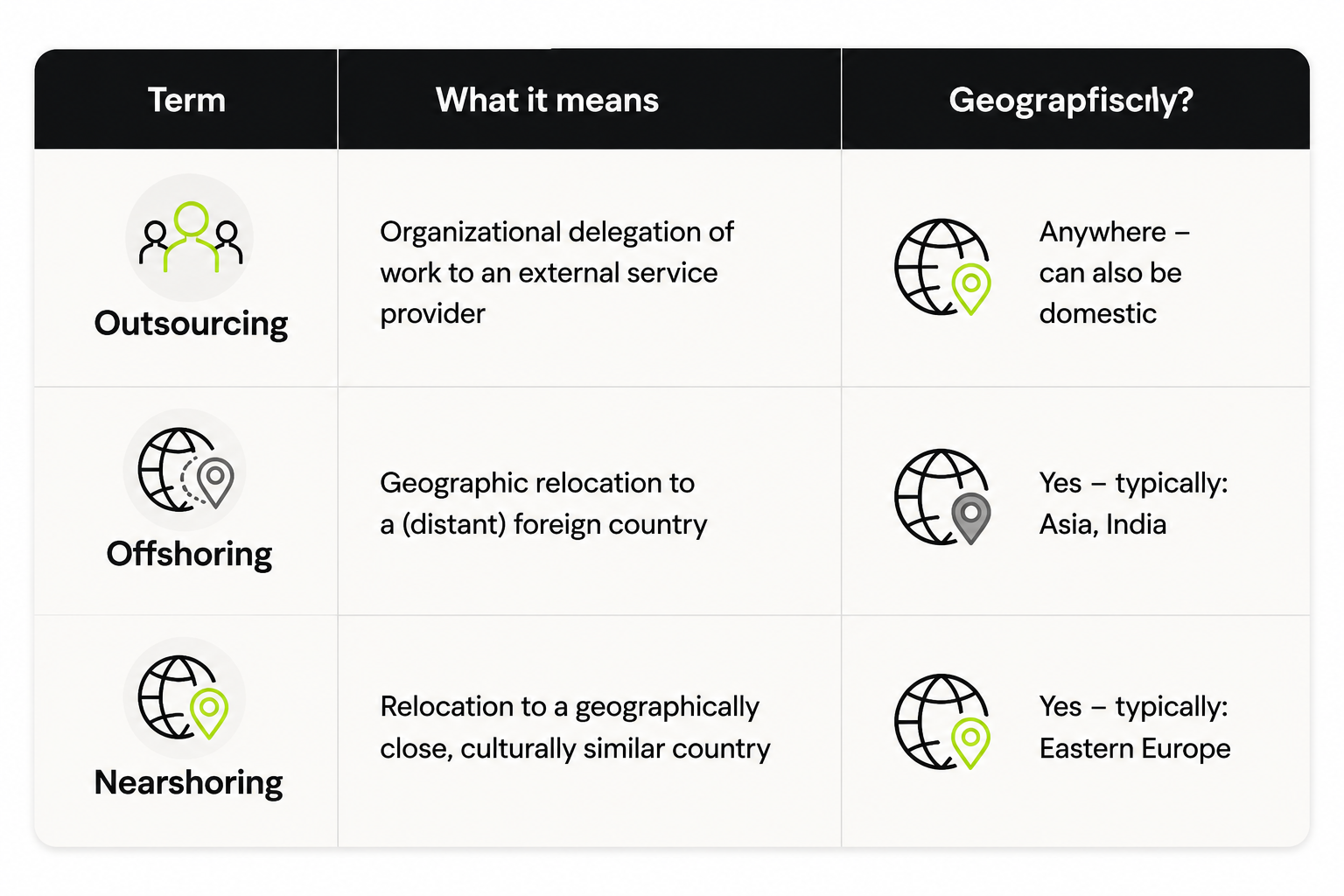
If a German startup commissions a development team in India, that's offshore outsourcing – so both at the same time. If the same startup opens its own office in India, that's offshoring without outsourcing. And if it works with a team in Serbia, that's Nearshoring.
For most founders and companies we know at KNGURU, in practice, it's about offshore outsourcing: assigning development work to an external team in a distant country – with the goal of saving costs.
Types of Offshoring in Software Development
Offshoring is not all the same. In software development, there are three variants that differ significantly in terms of effort and control:
1. Offshore Outsourcing
The most common variant: You hire an external agency or a development team abroad. You provide the requirements, and the team implements them. Low investment, but also low control over processes and quality.
2. Captive Offshoring
You establish your own subsidiary abroad – for example, a GmbH in India or Ukraine. This offers maximum control but also maximum effort: setting up the location, recruiting, administration, and navigating local legal frameworks. For early-stage startups, this is usually not a realistic option.
3. Hybrid Model
Part of the team is based domestically or nearshore, while another part handles clearly defined tasks offshore. This is often the most pragmatic approach – if it's well-structured. Anyone who also clarifies the question native vs. Cross-Platform can specifically decide which development tasks are suitable for an offshore team and which are not.
Advantages of Offshoring
Offshoring offers real advantages – otherwise, so many companies worldwide wouldn't rely on it. The most important ones at a glance:
Lower Hourly Rates
This is the most obvious advantage. Developers in India or Vietnam cost, on average, 20–40 Euros per hour. In Germany, the comparable rate is 80–120 Euros. On paper, this is an enormous difference – especially for larger projects.
Access to a Large Talent Pool
Germany faces a massive shortage of skilled IT professionals. Offshore markets like India, the Philippines, or Bangladesh have huge communities of highly qualified developers. For very specific technologies, offshoring can be the only way to quickly find suitable expertise.
Scalability
Offshore teams can be scaled up and down more quickly than a permanently employed in-house team. For projects with clearly defined phases, this can be a real advantage.
Time Zone Advantage – If Utilized
In certain setups, a team in a different time zone can work on a project around the clock. However, this requires very clear processes, clean handovers, and extensive experience with remote coordination.
Disadvantages and Risks of Offshoring
Let's be honest here – because most articles on this topic omit what offshoring truly costs in practice.
Time Zone Issues Eat Up the Cost Advantage
India is 4.5 hours ahead of Germany, and Vietnam is even 5 hours ahead. This means: queries sit overnight, feedback loops take 48 hours instead of 2, urgent corrections wait until the next morning. In an iterative app project, this quickly adds up to weeks of lost development time.
Cultural and Linguistic Misunderstandings
Even if the team is technically excellent: What makes a German user interface intuitive, what is considered "good UX" in the DACH region, how an onboarding flow should work – this is cultural knowledge that cannot be conveyed through a briefing document. Flawed developments due to misunderstandings are inherently more common in offshore projects.
GDPR and Data Protection
For apps that process personal data – which is virtually every app – GDPR requirements apply. As soon as data is transferred to a team outside the EU, clear contractual bases, Standard Contractual Clauses, or an adequacy decision from the EU Commission are required. This is feasible, but resource-intensive. Mistakes here can be costly.
Quality Control is More Difficult
The more geographically distant the team, the more effort is required to ensure quality. Code reviews, testing processes, clear Definition-of-Done criteria – all of this must be explicit and foolproof, because spontaneous queries and quick corrections inherently don't work.
The True Costs Are Higher Than the Hourly Rate
This is the point most founders realize too late. The low hourly rate is only part of the equation. This also includes: management overhead, rework due to misunderstandings, longer project durations, and time loss from asynchronous communication. In an honest overall calculation, offshoring is often more expensive than expected – and sometimes more expensive than Nearshore vs. Offshore it appears at first glance.
When Offshoring Makes Sense for App Projects
Offshoring is not a bad model – it's a model that suits some projects and not others. Here are the scenarios where it can work:
- Requirements are fully and clearly documented – leaving no room for interpretation
- Tasks are standardized and technically clearly defined (e.g., backend integration, data processing, testing)
- The internal team has experience with remote coordination and offshore management
- Time pressure is low enough to tolerate asynchronous communication
- GDPR requirements are reviewed and contractually secured
If even one of these prerequisites is missing, the risk of a failed or overpriced project increases significantly.
Conclusion
Offshoring is not a panacea – and not a mistake. It is a tool that works when used consciously and systematically. Anyone who believes they can simply save time and money with a cheap offshore team will be disappointed in most app projects. However, those who have clear processes, take GDPR requirements seriously, and outsource the right tasks can certainly benefit.
For most startups and companies in the DACH region, nearshoring – collaborating with teams in geographically and culturally close countries like Serbia or Poland – is the more reliable alternative. It offers short communication channels, the same time zone, and European data protection standards.
At KNGURU, we embrace this model daily: Leipzig and Niš, one time zone, over 200 projects. Not because nearshoring sounds better on paper, but because we've seen what truly works in practice.
Between agency life and startups - our blog
In our blog we share tips on app development, startups and a few wild stories from everyday agency life.

How to Integrate PayPal in Your App: A 2026 Guide
How to integrate PayPal into your app: integration paths, requirements, a step-by-step walkthrough and the mistakes that cost you conversions.Read story
Software Development Outsourcing: When It Pays Off
When does software development outsourcing pay off, which models exist and how do you spot a good partner? An honest take, hidden costs included.Read story
Low Code Development: When It Pays Off and When It Doesn't
What low code can really do, where its limits are and when custom development pays off more. An honest take with a 2026 platform comparison.Read story
Book your free call.
We look at your plans with you as if they were our own. If building does not pay off, we tell you, even when that speaks against the project.

Pick a day
Pick a day
Loading available times …